Why Your API Docs Are Your Most Important Marketing Tool
 Jamdesk Team
My co-founder and I ran an API company for years. We built social media APIs, sold them to developers, and competed against companies with bigger teams and deeper VC pockets. We won more than we lost, and when I look back at why, it wasn't just the API. Plenty of competitors had comparable endpoints. And it wasn't our pricing. It was our API documentation.
That sounds like a strange thing to say, but if you've ever sold a developer tool, you know exactly what I mean. Developers don't sit through demos and they don't read your homepage copy. They open your API docs, try to make a call, and decide in about ten minutes whether your product is worth their time. Their BS meter will have them running if your docs aren't solid.
Three Pillars That Built an API Business
At my previous company, we focused on three pillars: the API itself, our customer support, and our documentation.
- The API, of course, needed to be awesome, fully featured, stable, and meet our customers' need.
- For support we never used AI and always had a real person helping users - better to delay and answer than some crappy AI response.
- And finally the docs need to be amazing because they were the first impression developers had about us. The docs were treated as a product.
As a self-fulfilling prophesy, because we focus so much on writing good docs, they ranked well on Google. We didn't do keyword research or hire an SEO agency to SEO optimize the docs, but rather we wrote content that answered the actual questions developers were asking. Google mostly rewards that. Developers would find us through a search query, land on our docs, and realize the API did what they needed, fully by-passing out marketing homepage.
During sales calls, leads regularly told us how clear and well-written our API documentation was. We wrote everything ourselves, before AI writing tools existed, so no GPT drafts, no autocomplete, no "generate docs from code" shortcuts. Every sentence was deliberate, crafted by our team who understood the API because they built it. That discipline forced us to actually think about what developers needed to know, in what order, and what would confuse them. You can't shortcut that understanding with a prompt. That effort showed, and developers noticed. The key point isn't about not using AI to write you docs, but rather the content needs to be excellent.
The competitive advantage wasn't that we had docs. Everyone has docs. Ours were better because we treated them as a product, not an afterthought someone threw together before launch.
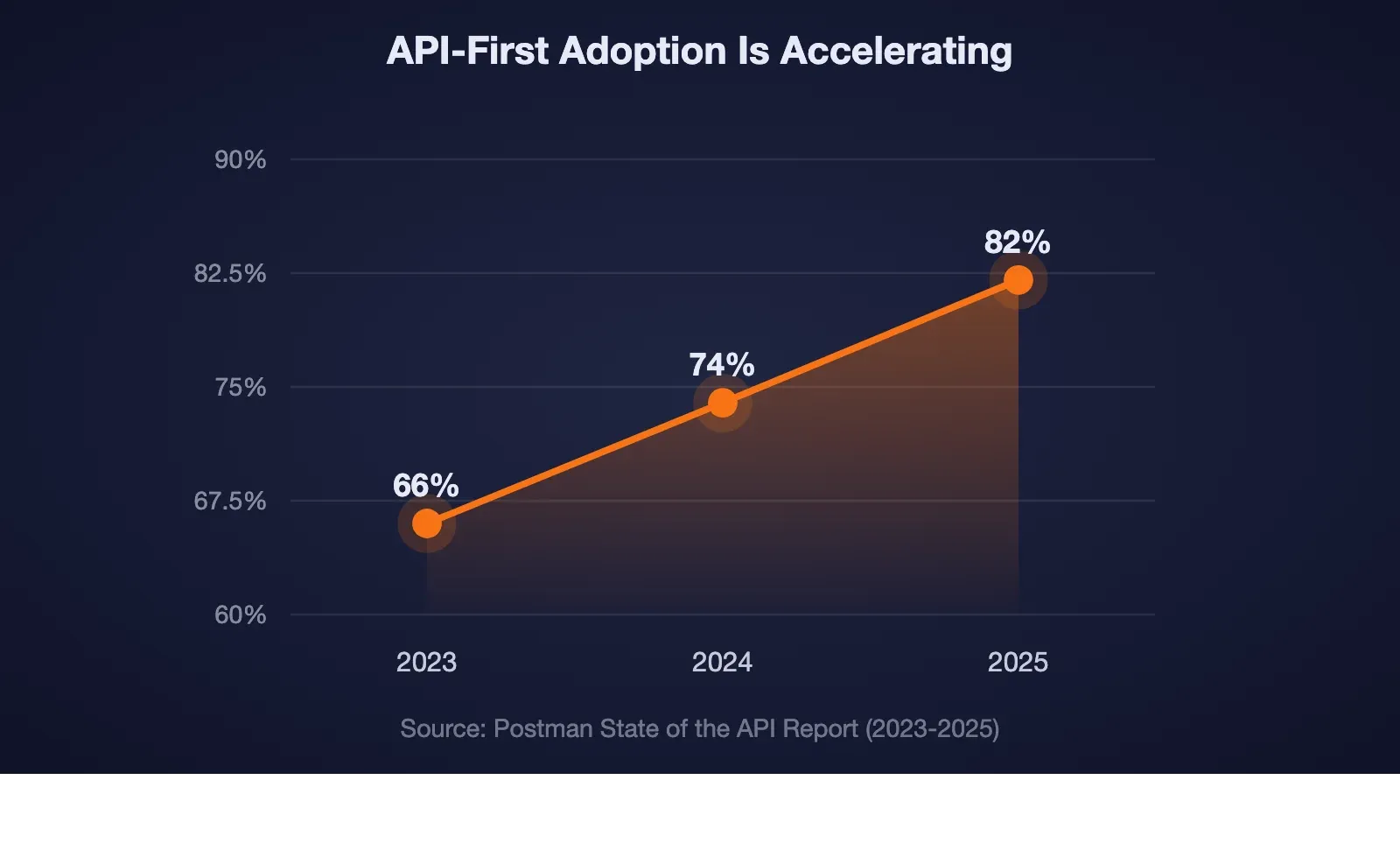
The numbers bear this out across the industry. Postman's 2025 State of the API Report found that 82% of organizations have adopted an API-first approach, up from 66% in 2023, and 65% now generate direct revenue from their API programs. If your API is a revenue line (and increasingly, that's the case), your documentation is the sales team working 24/7.
The Feedback Loop Powered Our Docs
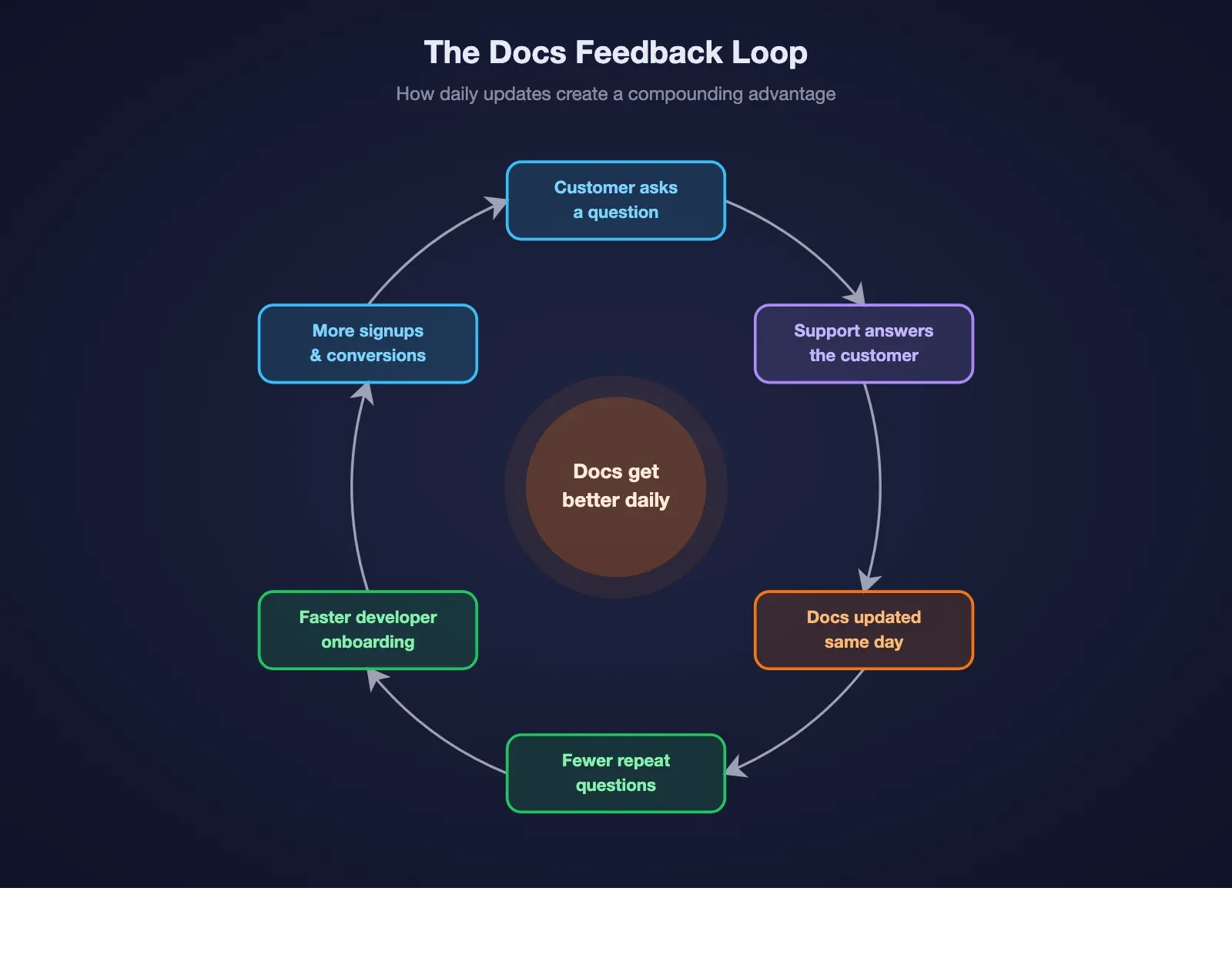
We updated our documentation daily - every single day!
The system was simple: a customer asks our support team a question. We answer them. Then we ask ourselves, "Would someone else ask this too?" If the answer was yes (and it almost always was), we updated the docs before the end of the day. Sometimes that meant clarifying a confusing parameter description. Sometimes it meant writing an entirely new section.
Over months, this compounds. Your docs absorb every real question your users have and fine-tunes everything. They become a living document that anticipates confusion before it happens. The next developer who hits that same issue just finds the answer already there. As a side note, no matter how good your docs are you'll still have users who rather ask someone than refer to docs - and that is ok - it is what the pillar 2 on support is all about.
You can think about this being a product management practice applied to documentation. Most companies don't do it because docs aren't owned by product. They're owned by nobody, sitting in some repo that engineering updates when they remember. When docs are nobody's job, they're nobody's priority.
The Cost of Getting It Wrong
The cost of getting this wrong is measurable. DX research found that developers spend 3 to 10 hours per week searching for information that should already be documented. For a 100-person engineering team, that's 300 to 1,000 hours lost every week, the equivalent of 8 to 25 full-time engineers doing nothing but hunting for answers. A 5-point improvement in Developer Experience Index from better documentation translates to roughly 5,000 recovered hours annually, or about $500,000 in productivity gains. What about AI agents? More on that later.
You know what bad docs look like. We all do. The quickstart guide that was written for version 1.0 and never updated. Response schemas that don't match what the API actually returns. Error codes with no explanation. Code examples that throw exceptions when you copy-paste them. No versioning, so you can't tell if you're reading docs for the current release or something three years old.
Every one of those failures is a developer who gave up and went to your competitor.
Why Bad Docs Lose, Good Docs Win
Think about how a developer actually evaluates your API. They don't read your marketing landing page. They might glance at pricing, mostly to check if there's a free tier or if their company will cover it. But the first real interaction is your technical docs.
Postman's 2025 report found that 93% of API teams struggle with collaboration challenges, including poor discovery and outdated documentation. Nearly every team shipping an API knows their docs aren't good enough, but they ship them anyway.
Can I find the endpoint I need? Are the parameters documented clearly? Is there a working code example I can run right now? Does the response match what the docs say it'll return? Can I try this without writing a full integration first?
That last question matters more than most companies realize. An interactive API playground (where a developer can fill in parameters and send a real request from inside your docs) compresses the evaluation from hours to minutes. They don't need to set up a project, install an SDK, or write boilerplate. They click "Try it," see a response, and know whether your API does what they need.
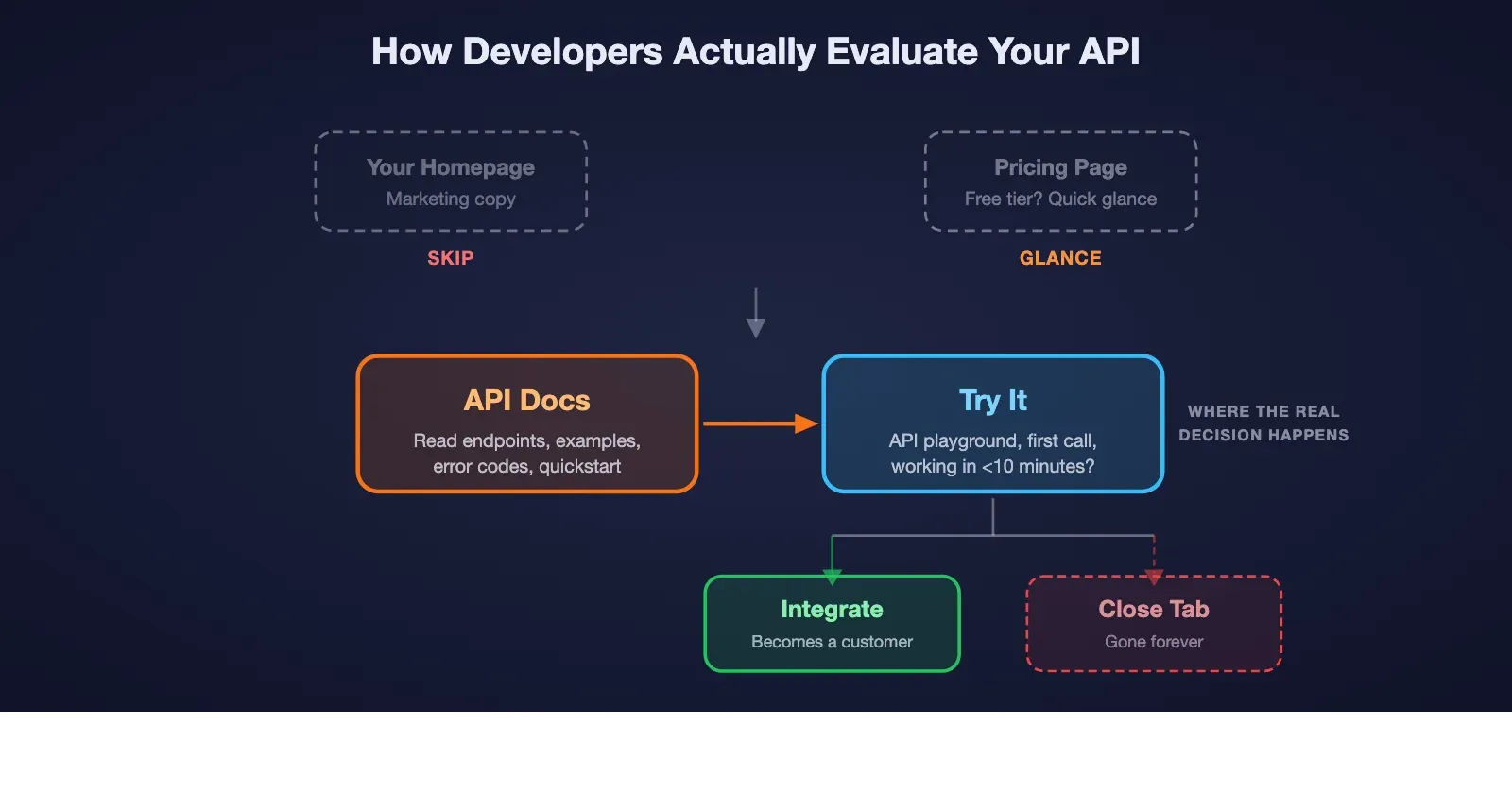
If a developer can't make a successful API call during their evaluation window, you've lost them. You'll never know. They won't email you or fill out a feedback form. They'll just close the tab and try the next option on their list.
The API economy is now worth an estimated $20 billion and growing at double-digit rates annually (Global Information Inc, 2026). Competition for developer attention is fierce. Your API documentation is often your only shot at a first impression. Make sure it's not the reason you're losing deals.
AI Changes Everything?
This is the part where you might expect me to say "AI changes everything." It does, but not in the way you might think.
Gartner predicts that more than 30% of the increase in demand for APIs will come from AI and tools using large language models by 2026. MCP — Anthropic's Model Context Protocol for connecting AI agents to external tools — exploded from 100,000 to over 97 million monthly SDK downloads in just 15 months (Pento, 2025) and it is well beyond that today. AI agents aren't a future thing. They're hitting your API docs right now.
What Each Audience Needs
The practical split looks like this:
| Human Developers | AI Agents | |
|---|---|---|
| Format | Beautiful, well-designed pages | Structured markdown, llms.txt, MCP |
| Priority | Working code examples, clear navigation | Machine-parseable content, schema definitions |
| Evaluation | "Can I make a call in 10 minutes?" | "Can I understand this API programmatically?" |
| Decision | Signs the contract | Recommends the API to the developer |
| Trust signal | Professional design, playground, search | Consistent formatting, complete coverage |
But I disagree with the "AI-first" crowd on one point: the human still makes the buying decision even if an AI recommends a product. A CTO doesn't let an AI agent pick the company's payment processor or communications API. A lead developer doesn't blindly integrate whatever Claude or Copilot suggests. They verify and read the docs themselves.
And the data backs this up. The 2025 Stack Overflow Developer Survey found that 46% of developers actively distrust AI tool accuracy. Only 3% say they "highly trust" it. When an AI agent recommends your API, the developer's next step is opening your documentation to verify the recommendation. If your docs are confusing, outdated, or ugly, the AI's endorsement means nothing.
So you need both. You need machine-readable formats: llms.txt files, MCP servers, and raw markdown endpoints. If you're not sure what that looks like in practice:
$ curl https://your-docs.example.com/llms.txt

# Your Product Docs
> Documentation for the Acme API

- [Authentication](/auth): API key setup and OAuth2 flows
- [Users](/api/users): Create, update, and list users
- [Webhooks](/webhooks): Event subscriptions and payloads
...
That's what AI agents read instead of crawling your site page by page. These are table stakes now. Without them, AI agents can't recommend what they can't read.
But you also need beautiful, well-organized, human-readable docs for the person who signs the contract. The docs need a professional design, logical navigation, working code examples, and an API playground where they can try a real request in 30 seconds. One without the other is half a strategy.
Yet Postman's 2025 report found that only 24% of developers currently design APIs with AI agents in mind. That's a massive gap. The companies that close it first will have a compounding advantage as AI-assisted development becomes the norm.
Your Docs Are Your Sales Team
Your documentation is doing more marketing work than your marketing team. Or it should be.
The operational discipline matters more than any tool: treat docs as a product, update them daily based on real user questions, and own them at the product level. In 2026 they serve two audiences, developers and AI agents, and most companies are only building for one.
Your best marketing asset might be the one your marketing team never touches.
How We Built Jamdesk Around These Lessons
Everything I described is why we built Jamdesk. Same philosophy: docs live in Git, deploy on merge, with a built-in API playground and auto-generated llms.txt. You can see it working on our own OpenAPI example page.
If your docs aren't pulling their weight, give it a try.